Plan for profit

Plan for profit

Plan for profit

How much is enough? How to plan for profit

Knowing how much income your farm needs to generate is an important question for farming success but it’s not always an easy one to answerA basic understanding of your farm’s income, expenses and your profit target is a good starting point. 

The formula for success

Your farm income must cover all the running costs of the farm to produce a farm profit. The farm’s profit is what pays back loans, pays taxes and is available to re-invest in your business as well as pays for your living expenses. 

So, to answer the question “How much income does the farm need to make?”, it is sometimes better to first determine how much profit is required to pay for these things. Having a profit target helps to understand the size and type of business you need to produce the income you require. We can use this simple formula below:

Farm profit target = Farm income - direct expenses - overhead expenses

Direct expenses are directly attached to farm production systems. For example, shearing costs for a sheep enterprise or chemical costs for cropping. Once these direct expenses are deducted from income, we have your farm’s gross margin. 

Overhead expenses are the ones you cannot avoid and are attached to the business whether it is producing or not. Examples include insurance, council rates, permanent workers, administration and accounting costs and vehicle registrations. Once the overhead expenses are deducted from the gross margin, we are left with farm profit. This is our target. 

One of the challenges of working through this equation is that often the numbers don’t add up –your profit target cannot be met because there is too little income left once direct and overhead expenses are deducted. 

 Some of the reasons may include: 

  • The farm is too small and cannot produce the required income 
  • Direct or overhead expenses are too high 
  • The expectations of the business are too high. 

Where the expectations of the business are too high, the business may be performing well but it can’t (and won’t) produce enough profit to fund all the that is asked of it. 

How to determine your target profit

When determining target profit, it is best to lay it all out on paper to ensure you include every expense, including living expenses that you are looking to support.  

Include items such as living expenses, medical costs, holidays, debts, capital investments on-farm, school and university fees and don’t forget to include a little extra for ‘other expenses’ that unexpectedly but inevitably pop up each year.  

If you’d like help working through a budget of your own, a RFCS Rural Financial Counsellor can guide you via phone or in person.

Profit planning - can it be done or are we asking too much?

Now that you understand what your target profit is, the planning process can be relatively simple. Your past financial records may show if you have a track record of generating this amount of profit. Looking forward, some simple budgeting, either by yourself or supported by your local Rural Financial Counsellor, will determine if the current scale and type of farm business is enough to meet the target profit.  

Of course, seasonal variations in yields and commodity prices have a big influence on the outcome. The lack of certainty in these factors makes it tempting to skip the planning process. However, the small amount of time and effort it takes is worth it to have outlook and confidence in decision making. 

It’s important to note that the financials prepared by your accountant aim to reduce tax and so deliberately play down the financial performance of the business. As such, you may need to carefully interpret your financials to get the real story of the business’s performance. Also, in your budgeting process, it is important to use average production and market prices so that you do not over or underestimate the capacity of the business. 

Remember, if after detailed analysis the target profit is unachievable, a realistic plan may need to include work off-farm to reduce the pressure from the business and provide for the needs of the family. 

Goal and strategy setting - how to identify short and long-term actions for generating income and reaching your target profit

Goals are the best way to identify what matters in our business. They determine where you are going to focus your time, energy and resources. Often, people start with broad or long-term goals like “To generate enough profit to cover all expenses and grow wealth for our family while operating our farm in a safe and sustainable manner”.  

The values expressed in a broader goal like this will help define the limits and opportunities of the business, so these need to be well-considered. For example, if being certified organic is part of the goal, then the boundaries are clear for your business straight away. 

However, following on from your broader goals, it is important to set SMART goals – specific, measurable, attainable, relevant, and time-bound. These SMART goals are usually shorter-term and will help drill down into the specific activities needed to reach the broader goal. Generally, there will be several SMART goals for your broader goal. 

A SMART goal may be to “Understand the individual gross margins of each crop and livestock enterprise in the business, and to assess against industry benchmark gross margins within the next six months”.  

The wrap

Having a target profit and a plan to achieve it will not make it rain or increase market prices. However, it will provide the framework to better understand the options and opportunities available to your business and make timelier and ‘bigger’ decisions more confidently. It helps lift you out of the detail to focus on the bigger picture and what can and needs to be done to improve your financial situation.  

Get in touch with your local Rural Financial Counsellor today to take advantage of their free, confidential and professional support to help you plan for profit. Call 1800 319 458.

  • Hits: 5
Decision Making

Decision Making

The business of farming is a constant process of making decisions. While decisions are often made on instinct, taking time to thoroughly consider the decisions you face is a highly valuable (and profitable) skill to develop.

Faith Rogers, a Rural Adversity Mental Health Program (RAMHP) Coordinator with Murrumbidgee Local Health District has seen many farmers grapple with making decisions.

“Farming has a lot of moving parts. There’s a lot of complexity in terms of scheduling, maintaining equipment, managing resources and looking after stock. As caretakers of the land, they want to treat their property well. They also want to run a profitable enterprise and take care of their families. But in farming, there are so many things people can’t control, so it’s about following the right processes for their business to make the best decisions possible to get the outcomes they’re seeking.”

We asked Faith to help us unpack the process of decision making and explore what it takes to master good decision making.

How we make decisions

Choosing a path that provides acceptable reward for acceptable effort at an acceptable amount of risk is at the core of decision-making and sound farm management.

The word acceptable is important here because each individual farmer has to define what acceptable means to them. People make decisions based on their values, goals, biases and personalities, so what is acceptable to one farming business in terms of risks and rewards may not be acceptable to the next.

There are many ways people tackle decision-making but generally it comes down to three approaches (or a combination of these things):

  1. The head:
    This is the logical approach to decision-making, where information is gathered, analysed and processed rationally.
  2. The heart:
    This is the emotional aspect of decision-making. It includes a farmer’s beliefs, values, fears and preferences. Sometimes these feelings (like a strong connection to the family farm) are deeply entrenched, making it hard to apply other approaches.
  3. The gut:
    This is intuition, which is shaped by knowledge and prior experience. It usually bypasses rational processes by linking past experiences (good and bad) with the present. Intuitive decisions often “just feel right”.

Not all decisions are created equal

Farmers make decisions every day, but not all decisions are the same. Some decisions are easy, with simple information inputs and clear right or wrong answers.  More complicated decisions will have an increased number of variables, and while it may not be immediately apparent, there is still generally a right answer.

Complex decisions usually involve the interaction between a number of complicated decisions that require outcomes to be weighed against each other. Generally, when facing complex decisions, we tend to move out of the ‘head’ and rely increasingly on the ‘heart’ and ‘gut’ to arrive at an answer. However, this is really the time when a logical, analytical decision-making process is of greatest benefit.

The personality factor

Of course, the way we tend to make decisions is, in part, determined by our personality and understanding your personality type can help you to identify your behaviour patterns and those of the people around you. And by creating awareness of your preferences and how you automatically react, it is possible to train yourself to do things differently and improve your decision-making skills.

The role of stress in decision-making

Some types of stress can be good and lead to favourable outcomes because they sharpen alertness and performance. But persistent stress over time – or chronic stress – can impair the decision-making process and potentially lead to inaction, or poor (and subsequently expensive) decisions being made.

While the ability to manage stress is an individual thing, in a highly complex business such as farming, it can make it difficult to stay on top of your game in terms of making productive and profitable decisions.

Stress affects the brain and this has an impact on judgement, planning and behaviour. Memory is affected, as is the ability to regulate emotion.

When stress is a factor, people tend to think in ‘all or nothing’ terms. They can’t see the differences in their circumstances and start catastrophizing, personalising and internalising what’s happening around them – thinking ‘Everything is ruined’, ‘Everyone else can get this right’ or ‘I’m the reason things are this bad’. 

How to make better decisions

Along with alleviating the impacts of stress, there are a few things you can do to become a better decision maker on your farm.

Often a purpose statement, outlining why you do what you do and what you want to achieve can help you stay on track. It’s easy to get bogged down in everyday problems and forget the bigger picture. A purpose statement is a reminder of where you’re going and provides a focus for our decision making: ‘Are my decisions in alignment with my purpose?’

Of course, as life happens and our goals change, remember to review your purpose statement to ensure it’s meaningful to where you are now and is still useful in decision making.

Accessing help

While decision making is constant in farming, it pays to remember that you don’t always have to face decisions alone. There are a number of people and organisations you can turn to when facing complex decisions, including:

  • Farm Advisory Boards: Farm boards provide a regular, formal meeting process to assist in strategic business management and can be a good platform for discussion and decision-making.
  • Advisors: Increasingly, farmers are turning to advisors with specialist knowledge to help inform their decision. Advisors are a good place to start if you’re looking for someone to bring their technical expertise or years of industry experience to the table. Advisors will include accountants, agribusiness specialists, agronomists and those with precision agriculture expertise.
  • Rural Financial Counsellors: Our counsellors provide an excellent sounding board for your ideas and can discuss with you a range of topics including cashflow management, budgeting, goal setting, and analysing business options, all while taking into account your individual situation and circumstances.

If you are experiencing stress, Faith also encourages you to reach out for help.

“If people are chronically stressed or they’re developing mental illness, there are avenues of support to lessen those impacts. I would encourage people to start by seeing their GP. Not only are they confidential and can diagnose what’s going on, they can also talk through a mental health care plan to ensure people can be subsidised to see psychologist if needed.

“On a lot of occasions, psychologists can help people take back a bit of control around their thinking by talking through some of the issues and helping with problem solving. Obviously if things get more serious and people aren’t coping, a higher level of intervention is needed. If people are having self-harm or suicidal thinking, they can present to the emergency department at their local hospital or seek a mental health assessment via telehealth. If the risk is acute, it’s best to call 000 for immediate assistance.”

To talk through goal setting, purpose statements or improving your decision making, contact  your local rural financial counsellor at RFCS NSW on 1800 319 458.

  • Hits: 5
RFCS NSW welcomes Craig Hough as new CEO

RFCS NSW welcomes Craig Hough as new CEO

Media Release

Rural Financial Counselling Service NSW welcomes Craig Hough as new CEO

The Board of the Rural Financial Counselling Service NSW has recently appointed Craig Hough to the position of CEO. Craig comes to the role with a wealth of experience in agriculture, farm policy, advocacy and leadership. He holds a Master of Business Administration, Master of Social Science and Bachelor of Arts.

“We are delighted to welcome Craig Hough to our organisation that has for 30 years been helping NSW farmers through many tough times,” says Chair of Rural Financial Counselling NSW, Anita Kemp.

“As a Government-funded, not for profit organisation we look forward to Craig bringing his leadership, policy and strategic skills to the role and deepening the relationships we have with our many stakeholders,” she says.

“With the extension of the Rural Financial Counselling Service NSW’s program deed by the Commonwealth Government for another two years, we are more motivated than ever to continue to provide best-practice, free, empathetic and ethical financial counselling to farmers who need our help,” says Anita.

Craig comes to the Rural Financial Counselling Service NSW from Australian Dairy Farmers Ltd. He was the Director of Strategy and Policy since April 2018. His responsibilities included leading policy analysis, industry development and political advocacy and engagement at the highest level of government. Some of his key achievements include designing the mandatory dairy code of practice, leading significant submissions to parliamentary and government inquiries and designing and delivering some of the Australian Government’s $22 million dairy support initiatives.

Prior to this Craig spent a decade in various roles in the Victorian Department of Primary Industries.

“After working in policy, strategy and project management for more than 15 years, this role as CEO will provide the opportunity to consolidate and deploy my skills and outputs over my career such as grant management, service delivery, strategy, advocacy and business administration. I look forward to getting back into service delivery, learning more about issues facing NSW farmers and providing essential support to them,” says Craig.

ENDS

RFCS NSW Media Enquiries:

Stakeholder & Communications Manager: Kate Anderson

This email address is being protected from spambots. You need JavaScript enabled to view it.

0487 731 788

  • Hits: 5
Recession Proofing Your Business

Recession Proofing Your Business

What is a Recession? Why are they inevitable?

Common thought is that recessions are usually caused by an unbalanced market. While we can’t always know when the next recession will come, or the long-term/short-term effect it may have, it’s a sure thing that another recession will eventuate in the economic cycle at some stage. It’s a case of not being ‘if’, but ‘when’ a recession may take hold.  

Recessions are usually triggered by either: 

  • External issues: e.g. war, weather events, foreign economic events 
  • Internal issues: e.g. economic expansion and contraction in our economy 

As business cycles have highs and lows of expansion and contraction, a recession will usually start at the top of the high as the market starts to slow down and contract. When two consecutive quarters of economic contraction are experienced, it is said to be a recession. 

Our top three tips to recession proof your business include: 

  1. Cashflow planning
  2. Business planning/Planning in advance
  3. Diversification

Managing your cashflow in recessionary times

When recession proofing your business, you need a clear picture of where you are and where you’re heading, this is where cashflow planning comes in. A cashflow forecast can help you to identify challenges that may occur in the future, opportunities for growth in your farm and is a must for at least the next 12 months. You should ask yourself questions like:  

  • Do I have any major repayments coming up such as repairs and maintenance? 
  • Do I have sufficient cashflow to meet my commitments? 
  • What’s your burn rate? (The amount you are spending each month to pay for overheads) 
  • Can I pay down any of my debt quicker? 
  • Should I diversify my income streams? 

Some farmers believe that seasonal conditions are too variable to rely on cashflow planning, but this is exactly why they are important. Understanding what your best, worst and average cash outcome might be can put you in a powerful position, and creating one or several cash flow scenarios does not have to be a difficult task.  

Utilise support from your accountant, a local Rural Financial Counsellor or other professional services to develop your cashflow plan. With the right tools and assistance this can be a quick and easy process giving you real insight into your finances. 

Business planning/Planning in advance

Thinking beyond today, or the current season, allows you to stand back, look in at your business and make assessments of how and what your business looks like. This is where a business plan comes in.  

Your business plan can help you prepare for ‘what if’s’ and support your business to be more resilient in tougher conditions or during natural disasters. You should create your business plan to meet the needs of your farm and what you are trying to achieve. It doesn’t have to be a large document, but it should be a living document that is monitored and fine-tuned regularly to ensure you are still meeting your business’s goals and objectives. 

Typically, when developing a business plan your Rural Financial Counsellor will focus on the following key elements: 

  • Goals: SMART (Specific, measurable, achievable, relevant and time-based) 
  1. Short to long term (five years out) 
  • SWOT analysis: Strengths, weaknesses, opportunities and threats 
  1.  How do we manage our weaknesses and threats? 
  2. How do we maximise our opportunities and strengths? 
    • Critical success factors: 
    1. What are the non-negotiables? For example: 

    a. Increase yields or productivity 

    b. Reduce debt 

    c. Lower input costs per tonne 

    d. Increase access to irrigation water 

    A good business plan will outline how achievements will be measured, and what success will mean for the business. Good business planning will then use that plan as the baseline to measure against. Are your products, and services right? How is the market response? How are the operations running? How are finances tracking?

    Good business planning should also highlight what you need to work on and expose any outside forces you didn’t perceive when developing the business plan. 

    Diversification - Why do it and how it can help your business?

    As the world’s population continues to grow and environmental challenges loom, it has become increasingly important for farmers to adapt and innovate. Diversification in farming refers to the practice of growing multiple crops, raising different livestock, or incorporating various agricultural activities on a single farm. 

    Diversification can bring many benefits to your farm business including: 

    • Reduced risk: Diversification in farming is risk mitigation. By spreading the production across various crops or livestock, farmers reduce their vulnerability to market fluctuations, pests, diseases and adverse weather conditions. 
    • Enhanced soil health: By diversifying crops, farmers can improve soil health and fertility by reducing the depletion of specific nutrients. Crop rotation, for instance, helps break pest cycles and replenish the soil. 
    • Increased resilience: Having a variety of crops and farming activities can help you cope with temperature fluctuations, droughts, and increased rain variability. 
    • multiple income streams. You may sell a variety of products, participate in farmer’s markets, or offer ecotourism experiences. 

    While diversification offers numerous benefits, it is not a one-size-fits all solution and success depends on factors like location, climate and the farmer’s knowledge and resources. Utilise support from your agronomist, accountant, or your Rural Financial Counsellor. 

    Start today

    The most important aspect of recession proofing your business is not to wait until crisis hits, start planning now. If you need help with the process, call 1800 319 458 to talk to one of our qualified Rural Financial Counsellors today. 

    • Hits: 5
    Farm Tax Planning

    Farm Tax Planning

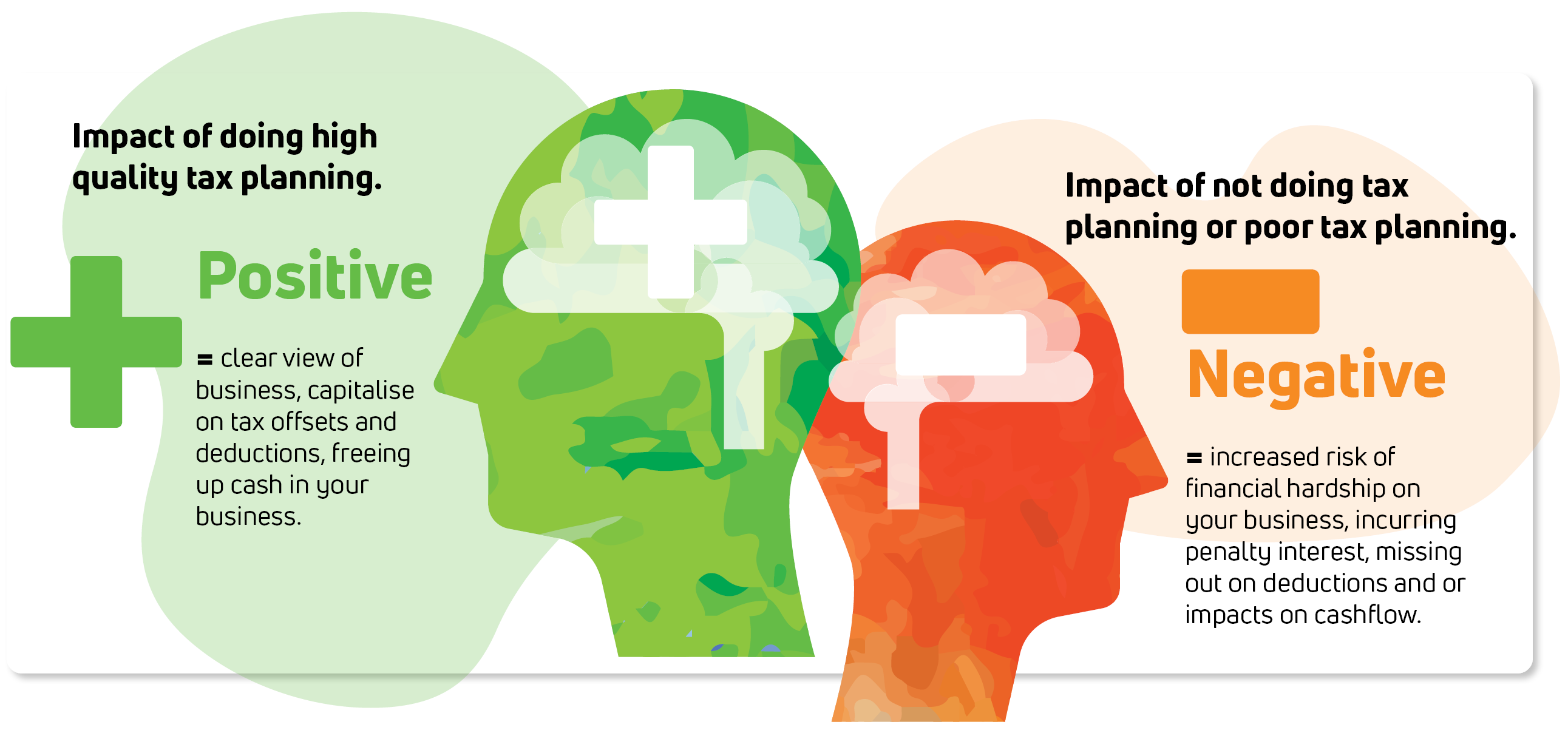
    If you’re in farming, tax planning should be part of the normal financial management of your business, as a well-devised tax plan can make all the difference between a significant tax bill or a comfortable financial position for your farm and family for current and future years.  

    The team at Rural Financial Counselling Service, NSW, have many years’ experience in understanding what it takes to manage the financials of a farm business and ensure it operates in the best possible financial position year-on-year and across generations.  

    When it comes to farm tax planning, RFCS NSW has three golden rules:

    1. Always talk to the professionals

    No matter how small or simple you think your taxes may be, a professional will know more about tax planning and the latest in tax compliance than you do and will do better by your business in terms of tax savings than you can alone. Afterall, while you spend most of your working hours running the farm, they spend most of theirs working taxes. A good tax advisor can help you understand your business position, level out the year-to-year peaks and troughs and support you in making well-informed personal and business decisions. 

    1. The earlier you start the better

    Tax planning is really a year-round process, but things tend to get serious around April each year after completion of the March quarter BAS when actuals for the first nine months are available. 

    The earlier you can start, the better prepared you and your accountant will be. Leaving things to the last minute (May or June) will likely see your accountant too busy and you with little chance of enacting any sort of plan for finishing the financial year in your strongest possible position. 

    1. Consider some of the big issues

    While having a tax professional on your side is imperative, their knowledge of your business is only as good as the information you give them. To get the most from your working relationship, it’s important that you know your business inside and out and spend some time considering some of the conversations and issues you are likely to discuss during the planning process, like: 

    • Farm Household Allowance reconciliations
    • Bringing forward or delaying income and expenses to pre or post 30 June
    • Trust distributions and the effects on beneficiaries
    • Review of Farm Management Deposits
    • Superannuation planning/contributions
    • Major capital purchases
    • Debt reduction
    • Changes in off-farm income
    • Impact of accumulated losses
    • Impact of deferred income/forced sales
    • Review of averaging position.

    For a farming business, there can be many options for improving your tax position - the key is to get in early and face the planning head-on with the guidance of your trusted tax professional.  

    If you’re not sure about the information you’re being asked to provide, it’s not up-to-date or you are worried things don’t look so great, chances are you’re not alone and there is help available to you.  

    Reach out to a specialist such as one of our Rural Financial Counsellors, who can help you prepare for your annual tax and work through any concerns with your financial situation.  

    At RFCS NSW we can guide you through your tax preparation work and help you to understand your financial position and develop an action plan to help you see your goals achieved. 

    RFCS NSW is a free service that provides you with access to a professional team of financial counsellors with knowledge across agriculture, banking, agribusiness, and a broad range of other industries.  

    We can guide you through reviews, negotiations with your lender, repairing bank relationships and other financial and business concerns, including goal setting, business plans and action planning. RFCS NSW is an independent and not-for-profit organisation with your best interests at heart.  

    With nothing to lose and plenty to gain, call 1800 319 458 to set up your free, confidential meeting today. 

    • Hits: 5